
The Universe in a Beer Bubble: The Dark Energy’s Hideaways, or How to Imagine the Unimaginable.
Imagination is more important than knowledge. Knowledge is limited. Imagination encircles the world.
Albert Einstein
Our perception of the world determines the speed with which civilisation develops. Its progress has continued through the millennia and will most likely continue into the future – unless artificial intelligence surprises us because, as history shows, our inability to imagine things that do not exist yet is an obstacle to change.
Examples abound. The wheel does not exist in the natural world. It had to be imagined and, once imagined, put to a practical use the consequences of which were extraordinary. The development of astronomy took a different course. The night sky, with the celestial bodies moving across it, was the universe’s mobile puzzle, with the Earth pinned at its centre for a short while. The meanders of the human thought show that the mainstream knowledge of the times is sometimes both an impediment to and an accelerator of fast-paced progress.
Charles Darwin experienced it when he first published his theory of evolution. The idea that humans had evolved from apes challenged the views of the scientific establishment because the world was estimated to date back some six to ten thousand years at that time. Evolution takes place not only in the natural world but also, or maybe first of all, in science, considerably speeding up at the moment. Today’s doctrines reveal themselves to be yesterday’s blunders.
The curious history of ideas surrounding human conception, as thrillingly outlined in Edward Dolnick’s The Seeds of Life, is a good example. World thinkers, early scientists and curious amateurs, trying to answer the now obvious question of where babies come from, navigated through the mystery in a series of experiments, both physical and thought ones. The point is quite obvious to a contemporary reader: scientific ideas can be misleading or fallacious not because they are ill intentioned, but because the interpretation of reality is defective at that particular moment in time.
We tend to construct models to imagine phenomena, processes and objects that cannot be directly perceived because they take place too quickly or too slowly. They are a representation of the concept they would like to describe, like the school model of the atom based on the arrangement of the solar system all of us can probably still remember. This cognitive substitute of reality helps us develop new theories that either end up in the bin of history or are validated through physical reality. As Richard P. Feynman remarked in one of his lectures, “[i]t doesn’t matter how beautiful your theory is, it doesn’t matter how smart you are. If it doesn’t agree with experiment, it’s wrong.” [CITATION[JG1] ]
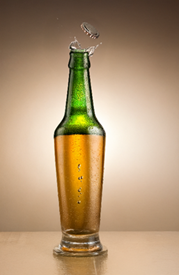
When walking on the Earth’s surface, we would think it is flat and infinite. But we know this is not the case and we are tricked by the scale and the perspective of our context. An astronaut in space does not share our vantage point and sees the Earth in a different way. A similar principle can be applied to the perception of the universe which also seems to be infinite when we are inside it. To date, we cannot change our point of view to see a larger perspective, even in our minds – but we could change the scale by, for instance, imagining a bubble of fizzy beer.
Take a bottle of beer, preferably a good quality lager to make my story easy to follow and enjoyable. As long as the bottle is capped, the lager stays clear, but as soon as we open it, gas bubbles appear, rising from the bottom and gathering volume. This familiar process has been studied by researchers at the Department of Geological Sciences at the University of Michigan [2]. The pursuit of “bubble fizzicks” was not only academic curiosity [2] but also an attempt to gain insight into natural processes such as gas-liquid interactions that drive explosive volcanic, lake and ocean eruptions.
If that is the case, we can use the beer bottle model to visualise the universe as a “fizz” bubble. The universe is currently estimated to have originated ca. 13.7 billion years ago from “nothing”, from a point, which call the Big Bang. Neither time nor space existed before the Big Bang, and something expanded from nothing. There could be some parallels between how we see the Big Bang processes and my bottle of beer. Once the bottle is opened, internal pressure is abruptly released. Gas, either CO2 or N2, accumulated in the beer, is diffused into bubbles on tiny particles and defects which are the nuclei of the future bubbles. [JG2] The velocity of the process and the bubble’s volume growth are initially extremely rapid due to high pressure difference. Beer particles are “forced” into the bubble alongside the gas.
This model can be an approximation of the Big Bang, albeit in miniature. The diffusing gas is the matter or its precursor in the model while the “beer” is the black hole as well as the dark matter. It also envisages extremely remote galaxies complex for their age and supermassive black holes, recently observed by the James Webb space telescope, which should not be there based on what we know about how the universe developed. Finally, the inside of a bubble is initially filled with “foam”, both with gas (matter) and tiny particles of the condensing beer (dark matter) as pressure and temperature decrease.[JG3] The model helps us imagine how such formations could emerge at the initial stages of the development of the universe in a relatively straightforward way and justifies the existence of large-scale rings formed by galaxies which are thought to have been formed solely by gravity in the current scientific model.
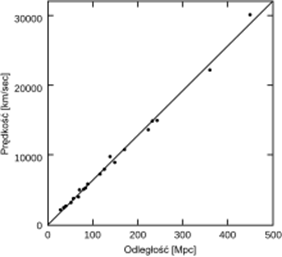
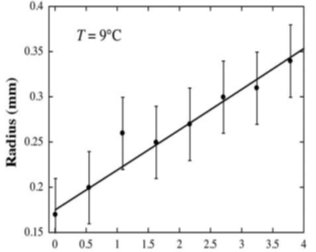
The universe is known to expand at the rate measured by the Hubble constant. If we compare the value of the Hubble constant [Fig 1][3] and the bubble growth rate during the ascent in beer [Fig. 2][2], we can see that the bubble growth model offers a good reflection of the behaviour of the infinite universe. Additionally, the activity of the universe’s macroforces shows that visible matter makes ca. 5% of the universe, dark matter, associated with partial black hole activity, ca. 25%, and dark energy ca. 70%. Science knows very little about the latter although it is believed to be responsible for the universe’s expansion. Dark energy has not been found to date and it is unlikely we will find it soon as, as my model shows, dark energy is outside the bottle. Cosmologists have recently expanded the current cosmological model to add a missing element, early dark energy whose density should decrease with the universe’s age. This is consistent with my model as the initial pressure difference outside and inside the bottle equalises with time.
There are other, equally promising aspects of the universe’s model envisaged externally as a small bubble surrounded by what seems to be an apparently infinite space from the inside. My beer bubble is evenly surrounded by beer – dark matter – forcefully acting on it on all sides. In the end, the field of dark matter equalises; however, the beer bubble is “sunk” in it. When viewed this way, Einstein’s “spooky action at a distance”, that is particle entanglement, is not spooky as distances do not seem overwhelmingly great from this perspective. The emergence and the disappearance of particles in a vacuum in such a small bubble in the beer bubble model are not surprising either. It hopefully reflects the laws of physics acting in a large-scale universe. Bubble growth rate as a function of external pressure, temperature, substrate density could shed light on the behaviour of their equivalents on the large scale of the universe. This is something mathematicians, astrophysicists and philosophers could calculate using analytical tools.
Five hundred years ago our universe was geocentrically limited to the solar system in our minds. Today we talk about the Big Bang and the infinite, expanding universe. It may be time to revisit our thinking on the standard model of the universe as observations increasingly challenge its accuracy. Possibly using a different perspective on what we are looking at could help us re-imagine the world around us.
With sincere thanks to PhD Joanna Kazik for the translation.
Zbigniew Sieradzki
Postscript
This model may not be the prettiest one. It may be naïve. But if it helps imagine what is unimaginable, it will make me happy. And to end, please do not ask me what the bottle is made from as I can’t imagine it – yet.
References:
[1] Dolnick, E. (2017) The Seeds of Life: From Aristotle to da Vinci, from Sharks’ Teeth to Frogs’ Pants, the Long and Strange Quest to Discover Where Babies Come From. Basic Books.
[2] Zhang, Y. & Xu, Z. (2008) “Fizzics” of Bubble Growth in Beer and Champagne. Volume, 4, 47-49. 10.2113/ GSELEMENTS .4.1.47
[3] Prawo Hubble’a-Lemaître’a. (5 March 2025). In Wikipedia. Prawo Hubble’a-Lemaître’a – Wikipedia, wolna encyklopedia